
Top-rated independent heating and cooling across Palm Beach County and the Treasure Coast
Pre-Season Cooling Checks Worth Doing
You want to know your air conditioning will hold up before the first stretch of ninety-degree days. Fair enough. Every spring we get the same calls from homeowners who ran the system fine in March and lost cooling the first week it really mattered. Here is what the season does to equipment across our service area, what breaks first, and what is worth checking now.
Call (888) 878-4879- A real person answers
- Open 7 days
- Written quote before work starts
Taking calls until 5:00 PM ET
By our service team · vetted by the techs who do this daily
What the warm season actually does to your system
Once the humidity settles in, your air conditioner stops cycling and starts running most of the day. That constant runtime is the real stress. Bearings, capacitors and contactors that coasted through mild weather are suddenly working ten or twelve hours at a stretch, and weak parts show themselves fast. Salt air and coastal moisture add the second problem. Coils, cabinet fasteners and electrical connections corrode, and corroded metal sheds heat poorly, so the system works harder to do the same job. Homes closer to the water see it worse, but inland properties still deal with condensate, mineral scale and dust. Nothing about it is dramatic. It is just load, and load finds the weak spot.
Which failures spike, and when
Early in the season we mostly see capacitors and contactors. They fail when the compressor and fan start demanding full duty after months of light use, and the symptom is a unit that hums or trips the breaker instead of starting. As runtime climbs into the hottest weeks, condensate problems take over. Clogged drain lines and full pans shut systems down on a float switch, which feels like a total breakdown but often is not. Late season brings the slow leaks and dirty coil calls, where cooling has been fading for weeks and finally cannot keep up. Blower motors and thermostats show up throughout. Timing matters because an early check catches the electrical failures before they strand you.
The checks a homeowner can safely do
Start at the thermostat. Fresh batteries, correct mode, and a setpoint that actually calls for cooling. Then look at your breaker panel and confirm nothing has tripped for the air handler or the outdoor unit. Change the filter, and if it looks grey and matted, change it more often than you have been. Walk outside and clear the space around the condenser. Cut back shrubs, pull out leaves and mulch, and give it a couple of feet of open air on every side. Inside, open every supply and return vent, including in rooms you keep closed. That is the safe list. Refrigerant, gas and high-voltage work belong to us, not to a weekend.
What we look at on a pre-season visit
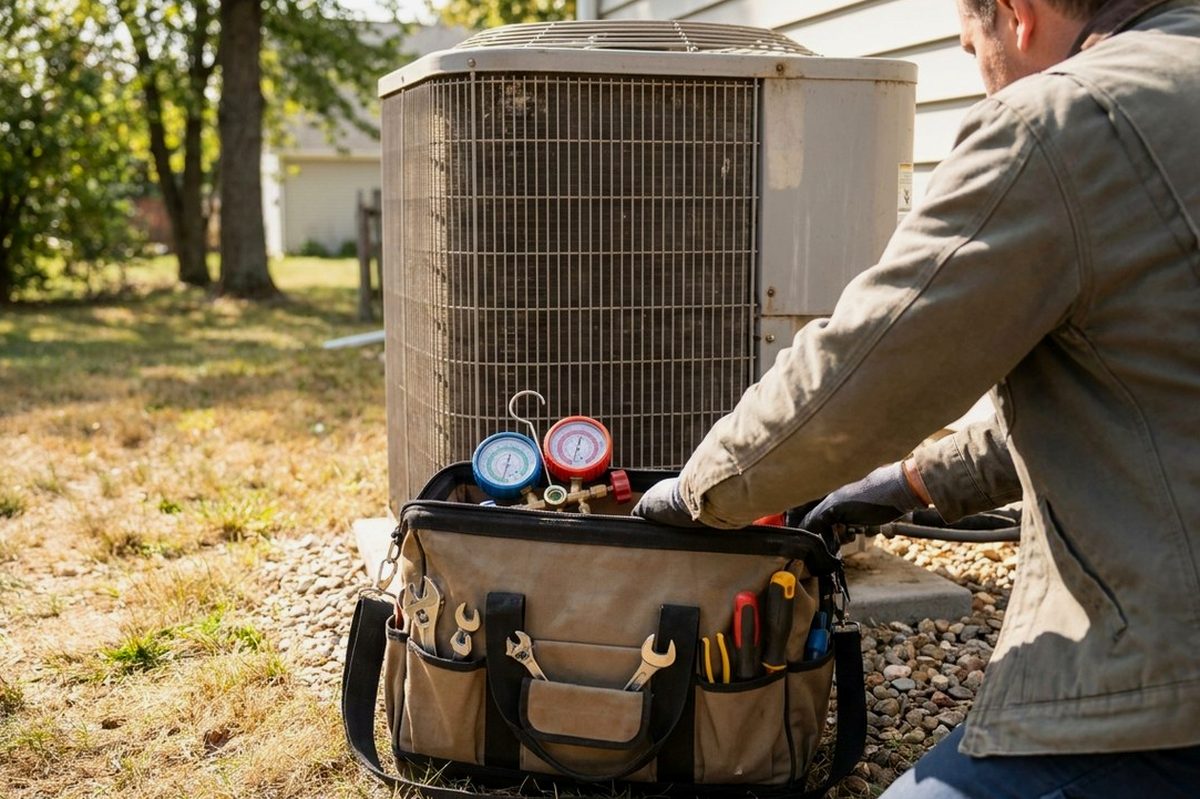
We measure rather than guess. That means checking amp draw on the compressor and blower, testing capacitors against their rated values, and looking at contactor points for pitting. We check refrigerant charge and temperature split, because a system that is low is also a system with a leak somewhere. Coils get inspected for corrosion and for the fin damage that coastal air causes over a few seasons. We flush the condensate drain and test the float switch, since that single item causes a lot of midsummer no-cooling calls. Wiring gets a look for green corrosion and loose lugs. If something is marginal, we tell you now instead of during the first heat wave.
Deciding between another season and a replacement
If your system is over a decade old, has a known refrigerant leak, and the cabinet is corroding through, another repair may only buy you a few months. We will lay out what the repair covers, what condition the rest of the equipment is in, and how much runtime it still has in it. Age alone is not a reason to replace anything. A well maintained air conditioner in reasonable shape can run a long time in Florida heat. What changes the math is repeated failures in the same season, a compressor that is drawing high amps, or ductwork and airflow problems that no new outdoor unit will fix. Call us and we will look before you decide.
Pre-Season Cooling Checks Worth Doing — common questions
When should I schedule a pre-season check?
Before the first sustained hot week, which in most of Florida means late winter through early spring. Booking early means we can order a part if something tests weak, instead of you waiting during peak season without cooling.
My air conditioner cools, so does it still need checking?
Usually yes. Weak capacitors, a partly blocked drain line and a slow refrigerant leak all cool acceptably in mild weather and fail once runtime doubles. A check finds those while they are still cheap and convenient.
How often should I change the filter?
Check it monthly and change it when it looks loaded. Homes with pets, construction dust or coastal air often need it more often than the package says. A dirty filter starves airflow and makes the whole system work harder.
How it works
- Step 1
Tell us the symptom
Call or fill in the quote form with what you hear, smell or feel. Warm air, ice on the lineset, a humming outdoor unit. That detail helps us load the right parts before we drive out.
- Step 2
We diagnose on site
We check the thermostat, the air handler, the condenser and the electrical side, then measure what the system is actually doing. You get a plain explanation of the fault and the repair options before we start.
- Step 3
We repair and verify
Once the repair is done we run the system and confirm temperature split, drainage and airflow at the vents. If a part is on order, we tell you the timeline instead of leaving you guessing.
- A real person answers
- Open 7 days
- Written quote before work starts
Why homeowners call us
- We plan for salt airCoastal humidity and salt eat coils, contactors and cabinet screws. We look for corrosion during every visit and treat it as part of the diagnosis, not an afterthought, so a repaired system does not fail again in the same spot.
- Built for constant runtimeFlorida systems run most of the year, so bearings, capacitors and drain lines wear faster than the manual suggests. We size repairs around that reality and point out the components likely to be next in line.
- Old houses and new onesIsland properties often hide ductwork in tight, damp spaces, while tract homes tend to have short, undersized returns. We have worked both and adjust the approach rather than forcing one standard fix.
- Clear talk, no upsell theatreWe tell you what failed, what it takes to fix it, and whether repair or replacement makes more sense for the age of the equipment. If a repair will hold, we say so and get on with it.
- All major brands, gas & electricIndependent service on Carrier, Trane, Lennox, Goodman, York and the rest.
- Straight answersWhen a replacement beats a repair, we tell you, sometimes before we roll a truck.
About this guide
Safe checks done and it still misbehaves? That's a real fault
Tell us what you tried and what it did. The booking itself takes a minute.
- A real person answers
- Open 7 days
- Written quotes
- All major brands
- Gas & electric
Rather not call? Get a free quote →